
Pakistan has once again requested the United States to provide it with drone technology, so that it can carry out operations against the Taliban and other extremist groups in the lawless tribal region along the Afghan border.

United States President Barack Obama would meet his Pakistani counterpart Asif Ali Zardari at the White House in WashinGton, DC on Friday and hold talks on issues of bilateral importance including combating terrorism.
Addressing New Delhi's concerns about peace talks with Taliban, the United States told India that it will not let the rebels enter a power sharing agreement in Afghanistan, according to leaked US cables by Wikileaks.
The Mumbai terror attacks, which were carried out by the Pakistan-based Lashkar-e-Tayiba terror outfit, closed the door for any Indo-Pak discussions on Kashmir, according to a top American diplomat.
"References made by President Obama did seem to suggest that there is some kind of a link between the settlement on Pakistan's western border and the Kashmir issue. Certainly that had caused concern," he told Karan Thapar's India Tonight programme. "I do think that we could make President Obama understand, if he does have any such views then he is barking up the wrong tree," he said.

"There seems to be a growing recognition that the Taliban and other miscreants, to use the Pakistanis own word for this, are a threat to the entire country and are alien to the spirit of Muhammad Ali Jinnah and the founders of Pakistan," Holbrooke said at a press conference after the meeting of Friends of Democratic Pakistan at the UN headquarters in New York on Thursday.
Special United States Representative for Afghanistan and Pakistan Richard Holbrooke said he would soon head towards the troubled region in South Asia to have a first-hand assessment of the situation on the ground.In his acceptance speech, soon after he was appointed as the Special US Representative for the troubled region by Secretary of State Hillary Clinton, Holbrooke termed the Pakistan situation as extremely complex.
The Obama administration is "disturbed" by the release of Jamaat-ud-Daawa chief Hafiz Mohammad Saeed, who was placed under house arrest nearly six months ago in the wake of the Mumbai attacks, US Special Representative Richard Holbrooke said on Wednesday.
'He has about as much chance of coming back to power as (former Soviet) President (Mikhail) Gorbachev,' The News quoted Richard Holbrooke, US administration's Special Representative for Afghanistan and Pakistan, as saying to a gathering of American diplomats and security experts.
Identifying Afghanistan and western Pakistan as one of the most dangerous parts of the world, special US envoy for Af-Pak on Monday said, the region poses a great threat to not only the United States, but also India and Western Europe.
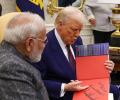
'The current strain in the relationship is serious and likely to be long lasting.' 'Even if Trump suddenly changes his attitude toward India -- which he is entirely capable of doing -- it is unlikely that New Delhi will be able to pick up the pieces and respond as if nothing has happened.'
The three most powerful elements of Pakistani politics, President Asif Ali Zardari, opposition leader Nawaz Sharif and the Army are "coming together" to fight the "common enemy" of terrorism, the top United States envoy to the Pak-Afghan region has said.
In his meeting with Richard Holbrooke on February 16, 2009 in New Delhi, the then Foreign Secretary Shiv Shankar Menon also thanked the Special Representative for US' role in pressing Pakistan to act on India's dossier on Mumbai attacks and said that it was "remarkable that we got this far".
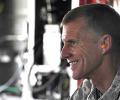
America's top commander in Afghanistan, Gen Stanley A McChrystal, and his advisors have reportedly ridiculed United States Vice President Joe Biden, President Barack Obama's Special Envoy to Pakistan and Afghanistan Richard C Holbrooke and the US Ambassador to Afghanistan Karl Eikenberry.

The start of Indian lobbying in the US can be traced back to Pakistan's anti-India lobbying. Policy wonk Ashok Sharma documents this journey and its catalytic role in transforming the US-India relationship.

'The US-India relationship is in a different league altogether,' Obama administration officials tell Aziz Haniffa/Rediff.com in Washington, DC.

On Thursday, November 6, the Washington Post newspaper reported that controversial American diplomat, Ambassador Robin Raphel, had her office and home searched by the FBI. This most unusual development likely raised much cheer at India's ministry of external affairs, in whose flesh Raphel had been a thorn through much of her tenure in the first Bill Clinton administration in the early and mid-1990s by her anti-India and pro-Pakistan stand. Seventeen years ago, as she was about to step down as Assistant Secretary of State for South Asian Affairs, Raphel granted an exclusive interview to Aziz Haniffa and India Abroad, the leading Indian-American weekly newspaper, which is now owned by Rediff.com The July 1997 interview, which provoked a raging controversy in both capitals, Washington, DC and New Delhi, is reproduced here...
